How to Set Up a Japanese-Style Recycling Station in a Small Kitchen
Disclosure: This post contains affiliate links. If you buy through them, I may earn a small commission at no extra cost to you. It doesn’t change which products I include or what I say about them.
Japan is known for sorting its trash carefully, and living here, I can tell you the hard part isn’t the sorting. It’s where to keep everything until pickup day, in a kitchen with no room to spare.
I live in a small apartment in Kasukabe, a city just north of Tokyo. This post shows how sorting works in my city, how I handle it at home (honestly, not very elegantly), and what a tidier setup could look like with a few slim Yamazaki products. If your city asks you to separate recyclables, or you just want your trash and recycling to take up less floor space, the same ideas apply.
To be upfront: I haven’t used the Yamazaki products below myself. The product details come from the manufacturer’s listings and buyer reviews on Amazon. The sorting rules and schedule come from my city’s official trash calendar.
How trash sorting works in my city
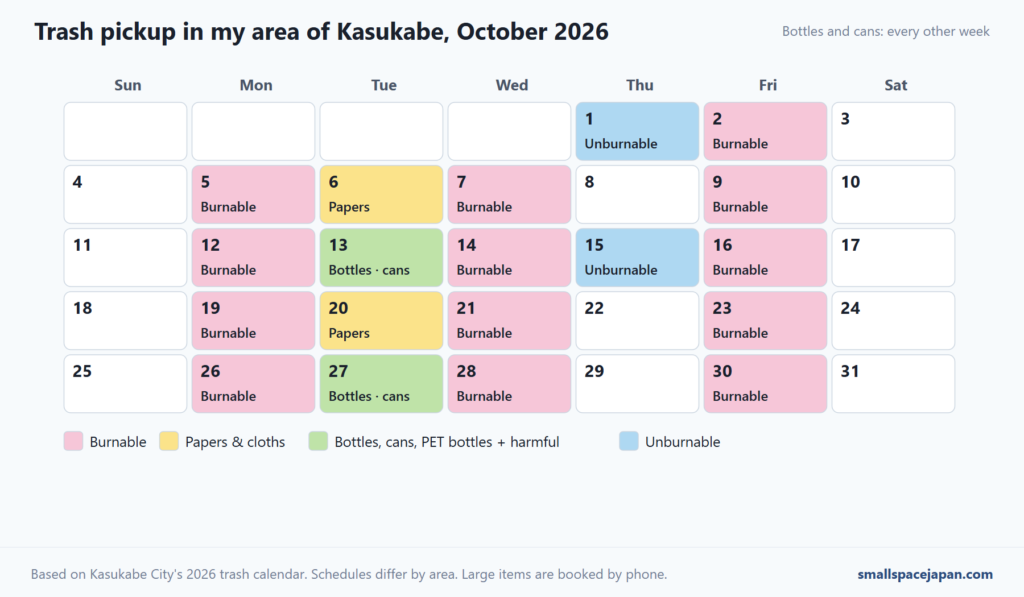
Kasukabe publishes a yearly trash calendar, with the categories written in Japanese, English, Vietnamese, Chinese and Korean. In my area, the regular categories and pickups look like this:
| Category (as named on the calendar) | Pickup in my area, October 2026 |
|---|---|
| Burnable Garbage | 3 times a week |
| Papers and Cloths | Twice a month |
| Bottles, Cans and PET Bottles | Twice a month |
| Harmful and Dangerous Garbage | Twice a month, on the same days as bottles and cans |
| Unburnable Garbage | Twice a month |
Large items, anything longer than about 50 cm (20 inches) on one side, are picked up separately: you call and book a pickup.
The schedule is what shapes your kitchen. Burnable trash goes out three times a week, so it never piles up. But bottles, cans and plastic bottles go out only every other week. If you miss a pickup day, they stay in your home for up to four weeks. That’s the one part of sorting I find annoying: when the timing doesn’t work out and the bags just sit there.
My setup (the honest version)
My system is simple: plastic shopping bags from the store, set on the kitchen floor, one per category. It works and costs nothing, but the bags take up floor space in a kitchen that has very little of it.
The only part I’d call “designed” is a slim pedal trash can for burnable trash, which lives in the gap between my fridge and a cupboard. The gap is about 25 cm (10 inches) wide, and the can is about 20 cm (8 inches). That gap would otherwise be wasted.
So here’s what I’d change if I were setting it up properly, and the Yamazaki products that fit each step.
Step 1: Learn your city’s categories
Every city is different, so start with your own city’s rules. Whether you sort into two bins or six, write the categories down and decide how many containers you really need. Most of the space problem comes from containers that are too big for what goes in them, or too few for how often things are collected.
Step 2: Rinse and dry before sorting
In my city, milk cartons are rinsed and dried before they go out. Wet recyclables smell and leave sticky bags behind, which is the last thing you want in a small kitchen.
A drying stand that holds bottles and cartons upside down helps here, and it takes up very little counter space. I wrote about the Yamazaki Multi Eco Stand, which Yamazaki sells in Japan as a “plastic bag eco holder,” in this guide to its uses.
Step 3: Use bags on a stand instead of bins
Bins take up the same space whether they’re full or empty. Bags held open on a stand do the same job, take less room, and are easy to lift out on pickup day. This is what my floor-bag system is trying to be.
Yamazaki Grocery Bag Holder (Tower or Tosca)
A foldable steel stand that leans against a wall or cabinet and holds plastic bags open. According to the listing, it has several hooks, so you can hang more than one bag and sort as you go. When you don’t need it, it folds flat.
- Size: 12.2 × 10.2 × 19.7 in (as listed), 3.6 lb
- Holds: bags up to 45 liters
- Versions: Tower in black, or Tosca in white
- Rating: 4.6★ from about 1,150 ratings (both versions together)
Good to know: I couldn’t read detailed buyer reviews for this one, so I can’t tell you what people complain about. The high rating from over a thousand buyers is a good sign, but check the dimensions against the spot where you plan to lean it.
Step 4: Put the gaps to work
This is my favorite part of the setup: use the narrow spaces. A slim bag holder can go between the fridge and the wall, beside a cabinet or at the end of a counter.
Yamazaki Tower Slim Trash Bag Holder with Lid
A tall, narrow steel frame with a lid. The bag hangs inside the open frame, and the lid lifts off when it’s time to change it. At 7.48 inches (19 cm) wide, it would fit in the gap beside my fridge.
- Size: 15.75 × 7.48 × 21.26 in (L × W × H), 4.63 lb
- Fits: 45-liter (12-gallon) bags
- Colors: black or white. Also sold as a set of two
- Rating: 4.2★ from 130 ratings (the set of two: 4.5★ from 60)
A buyer in Japan bought it for the space between their fridge and the wall, and says it fit just right and is stable. Another bought two, one for plastics and one for plastic bottles, and says the bag stays firmly in place instead of slipping off like it did in their old bin.
Good to know before you buy
- The bag is visible. With a clear bag, everything inside shows, so think about where it will sit.
- The lid isn’t airtight. Buyers in Japan say strong smells can escape and that it’s better for recyclables than for food scraps. One also found the lid loud when it closes.
- It may ship from overseas. The listing appears to be a Japanese-market product, and a buyer in San Francisco says it took a long time to arrive.
- Several buyers say it’s expensive for what it is.
If you have a slightly wider gap and want shelves instead, see my guide to slim rolling carts for the gap next to your fridge.
Step 5: Size it for the slowest pickup
Here’s the lesson from my own kitchen: plan your containers around the category that’s collected least often, not the one you use most. For me, that’s bottles, cans and plastic bottles, which can sit for two weeks or more. A container that holds two weeks of those, plus a quick rinse-and-dry habit, is what keeps the whole system from overflowing.
A simple small-kitchen setup
- A drying stand by the sink for rinsed bottles and cartons
- A bag stand with several hooks for the categories collected every week or two
- A slim lidded holder in a narrow gap for the category that fills up fastest
- A small bin for burnable trash or food scraps, emptied often
You don’t need all of it. Even a single slim holder in a gap that’s currently wasted can take a pile of bags off your floor. I’m still at the shopping-bag stage myself.
Star ratings and rating counts are from Amazon.com product pages as of October 2026 and may have changed. Counts include ratings from other Amazon stores. Product details are from the manufacturers’ listings.
Sources:
- Kasukabe City, 2026 trash collection calendar (in Japanese, with English, Vietnamese, Chinese and Korean)
- Yamazaki Home product listings on Amazon.com